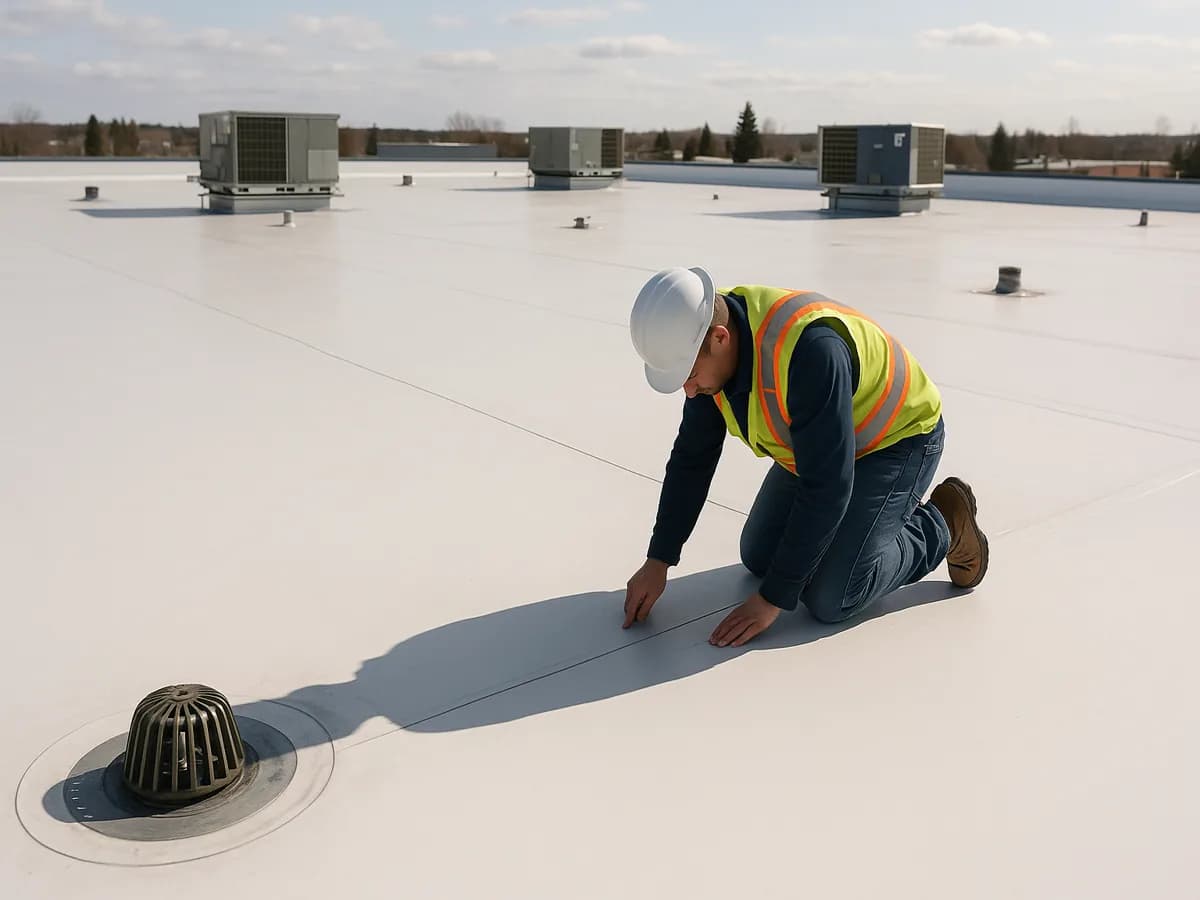
Flat and low-slope roof repair for EPDM, TPO and modified bitumen — sealing leaks and ponding.
What flat roof repair involves
Flat and low-slope roofs — common on commercial buildings, additions and modern homes — use membrane systems like EPDM rubber, TPO and modified bitumen. Their most common problems are ponding water that never drains, split or shrinking seams, and punctures. We diagnose the membrane type, repair seams and flashings, address drainage, and patch or recoat where appropriate.
What's included
- EPDM, TPO and bitumen systems
- Ponding and seam repair
- Membrane patching
- Free written quote
Built for the Canadian climate
Because flat roofs hide leaks well, water can travel along the deck before it shows inside, so we inspect the whole field, not just the obvious spot. Across Canada, snow load, ice dams and freeze-thaw cycles are hard on roofs, so we detail every job for the weather it will actually face. On low-slope roofs we trace ponding water and open seams back to the membrane and flashing details, because a flat roof almost always leaks at its transitions and penetrations long before it fails across the open field.
Common flat-roof problems we fix
Low-slope and flat roofs fail differently from sloped roofs. The usual culprits are ponding water that never drains, seams that split or shrink as the membrane ages, punctures from foot traffic or debris, and failed flashing where the roof meets walls, drains and rooftop units. Because the water has nowhere to run, even a pinhole can leak steadily.
Our flat-roof repair process
We identify the membrane type — EPDM rubber, TPO, or modified bitumen — because each is repaired differently. We clean and inspect the field and every transition, then repair seams and flashings with compatible materials, address drainage and ponding, and patch or recoat where the membrane is sound but worn. We inspect the whole roof, not just the visible stain, because water travels along the deck before it shows inside.
Repair, recoat, or replace
Not every aging flat roof needs replacement. A membrane that is intact but weathered can often be recoated to add years of service for a fraction of the cost. One that is brittle, blistered or leaking in multiple areas is usually better replaced. We give you the honest read after the inspection so you can plan the spend.
How we find a flat-roof leak
Flat roofs are the hardest roofs to diagnose because water spreads across the deck before it shows inside, and the entry point is rarely above the stain. We inspect the entire membrane field, every seam, and each flashing and penetration, and where needed we flood-test or use moisture detection to confirm the source before we open anything. Guessing on a flat roof wastes money and patches the wrong spot — confirming the source first is what makes the repair hold.
Extending the life of a flat roof
A flat roof rarely needs to be replaced all at once. With regular inspection and minor maintenance — clearing drains, resealing flashing, repairing seams as they begin to open — a sound membrane can serve well past its nominal life. When the field membrane is intact but weathered, a compatible coating can restore the surface and add years for a fraction of replacement cost. We tell you honestly where your roof sits on that curve so you can plan the spend rather than react to a failure.
Caring for a flat roof over its full life
A flat or low-slope roof rewards attention and punishes neglect more than any other roof type, because its failures are slow, hidden, and concentrated at a few predictable points. The membrane field itself often outlasts its rated life when it is looked after; what fails first are the seams, the flashing at walls and curbs, and the drains. A small program of regular inspection and minor maintenance — clearing the drains so water moves off the roof, resealing flashing before it opens, and repairing seams at the first sign of separation — routinely adds years to a flat roof for a fraction of the cost of replacement. When the field membrane is sound but weathered, a compatible coating can restore the surface and extend its service further still. We assess where your roof actually sits on that curve and give you the honest options: a targeted repair, a maintenance plan, a recoat, or — only when it is genuinely warranted — a full replacement. The goal is to get every year the roof has to give rather than replacing it before its time or letting a small problem become a soaked deck.
Commercial decks, additions and modern homes
Low-slope roofs turn up on more than warehouses. We repair the flat decks over commercial buildings, the membrane roofs on modern and mid-century homes, and the low-slope sections over additions, porches and dormers on otherwise sloped houses. Each uses a membrane system that fails in its own predictable way, and each is diagnosed and repaired on its own terms rather than with a one-size patch.
Get a free written quote
Every flat roof repair project starts with a free, no-obligation written quote based on a real inspection of your roof. We confirm the scope, materials and price before any work begins, and back the work with a workmanship warranty.