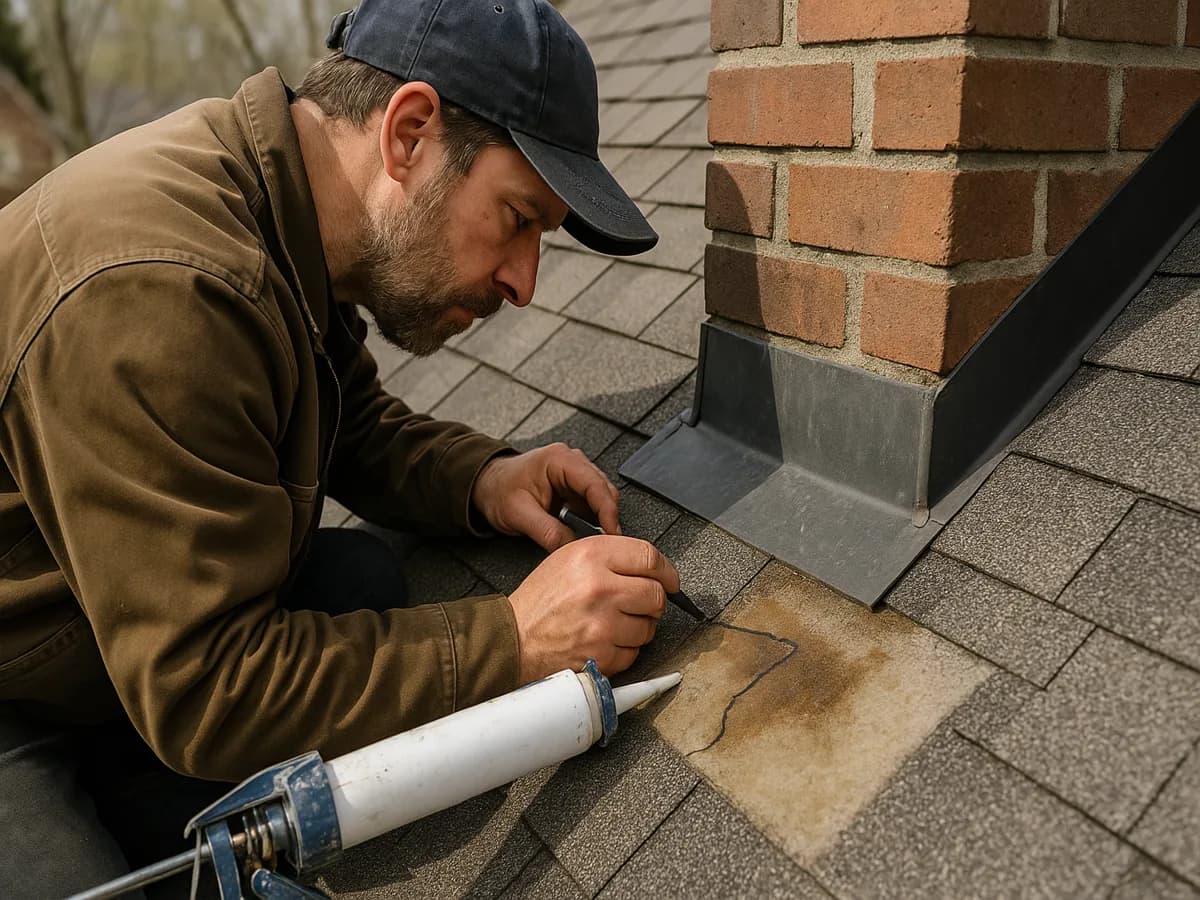
Targeted roof leak repair — we trace the source, fix it, and verify the roof is watertight.
What roof leak repair involves
A roof leak is rarely where the stain is. Water enters at a failure point — flashing, a valley, a vent, a nail pop — then runs along the deck or a rafter before dripping through the ceiling. Our leak repair starts with finding the true entry point, then sealing it properly: re-flashing, replacing damaged shingles or membrane, renewing sealant, and verifying the repair holds.
What's included
- Source tracing
- Flashing and valley repair
- Watertight verification
- Free written quote
Built for the Canadian climate
We document what we find so you understand the cause, not just the symptom, and we confirm the roof is watertight before we leave. Across Canada, snow load, ice dams and freeze-thaw cycles are hard on roofs, so we detail every job for the weather it will actually face. Because water can travel several metres along a rafter or down a layer of sheathing before it drips inside, we locate the true point of entry first — a step a quick surface patch almost always skips.
Why finding the source matters most
A roof leak rarely enters where it shows up inside. Water runs along rafters, sheathing and pipes before it drips, so the stain on your ceiling can be metres from the real entry point. This is why chasing the stain with sealant almost never works. We trace the leak back to its true source — a failed flashing, a cracked vent boot, a lifted shingle, an ice-dam backup — and fix the cause, not the symptom.
Our leak-detection process
We inspect the roof surface and every penetration, then check the attic underside where water tracking and daylight reveal the entry point. Where needed we water-test sections of the roof to confirm the source before any repair. Only once we are certain of the cause do we quote and complete the repair, then re-test to confirm the leak is sealed.
Acting before the damage spreads
A small roof leak is cheap to fix; the damage it causes is not. Left alone, water rots sheathing and framing, soaks insulation so it stops working, stains and collapses drywall, and creates the damp conditions mould needs. Calling at the first stain almost always means a smaller, less expensive repair than waiting for the next storm.
Common sources of a roof leak
Most leaks come from a short list of failure points, and knowing them is half the diagnosis. Flashing around chimneys, walls, skylights and vents is the single most common culprit, followed by cracked or perished vent boots, shingles lifted or lost in a wind event, ice dams forcing meltwater back under the shingles at the eaves, and clogged valleys or eavestroughs that let water back up. We check every one of these systematically rather than assuming the cause from the stain alone.
What happens if a leak is ignored
A roof leak never improves on its own. Left alone, the water keeps tracking into the structure: it saturates insulation so it loses its R-value, rots sheathing and framing members, stains and eventually collapses drywall, and creates the persistent damp that mould needs to take hold. What begins as a single ceiling stain and a modest repair can become a structural and air-quality problem that costs many times more. The cheapest time to fix a leak is always the first time you notice it.
How we find and fix the true source of a leak
The hardest part of stopping a roof leak is not the repair — it is finding where the water actually enters, because it almost never enters above the stain. Water runs along rafters, sheathing, pipes and wiring before it finds a place to drip, so the mark on your ceiling can be metres from the breach. This is why sealing the stain from inside, or smearing tar on the nearest suspicious spot, so rarely works: it treats the symptom and leaves the cause. Our process is built to find the cause. We inspect the roof surface and every penetration, then go into the attic where water tracking, staining and daylight reveal the real entry point, and where the source is still unclear we water-test the roof section by section until we can prove where it gets in. Only once we are certain do we quote and complete the repair, and then we re-test to confirm the leak is sealed. Fixing the cause once, properly, is cheaper than chasing the same stain through three rounds of sealant — and it is the only approach that actually keeps the water out.
Catching a leak before it spreads
A leak found early is a small, contained repair; the same leak found after a winter of quiet damage is a much larger one. That is why we treat every reported leak as worth tracing properly the first time, whether it is an active drip during a storm or a faint stain that only appears in heavy rain. The sooner the source is found and sealed, the less of your home the water touches and the smaller the repair stays.
Get a free written quote
Every roof leak repair project starts with a free, no-obligation written quote based on a real inspection of your roof. We confirm the scope, materials and price before any work begins, and back the work with a workmanship warranty.